

Managing Gutter Overflows in High-Rainfall Summers
Gutter overflows spike during summer storms because sudden heavy rainfall overwhelms systems clogged with cottonwood fluff, seed pods, and shingle grit. Ease Your Panes explains how to prevent overflow and protect your home's exterior.
- Summer cloudbursts push more water through gutters in minutes than slow rain does in hours. Partial clogs from cottonwood seeds and debris cause water to back up and spill over the edge.
- Clear gutters in early June after fluff stops falling, flush downspouts with a hose, and check pitch for proper drainage. Re-inspect after each major storm since one cleaning will not last the season.
- Repeated overflow on clean gutters signals undersized systems that may need 6-inch gutters or larger downspouts. Overflow also damages windows and siding by leaving mineral streaks and promoting rot.
Gutter overflows occur more frequently in summer because intense downpours push large volumes of water through gutters in short periods. When this sudden rush of water encounters even a partial clog from leaves or debris, it backs up quickly and spills over the edge. Slow winter drizzles move water gradually, giving gutters time to drain properly even with minor blockages.

Why Gutter Overflows Spike During Summer Storms
Summer downpours push more water through a gutter in ten minutes than a slow spring drizzle sends in an hour. When that water hits a partial clog, it backs up fast and spills over the edge. This is why gutter overflows become a summer problem, not a winter one.
Along the Front Range, summer means sudden afternoon cloudbursts. A quarter-inch of rain in fifteen minutes is common in July. Gutters sized for steady rainfall cannot move that volume when leaves, seed pods, or shingle grit block the flow.
Below, you learn what causes summer overflow, how to catch it early, and the specific fixes that keep water moving during a high-rainfall stretch.
What Causes Gutter Overflows in High-Rainfall Summers
A gutter overflow happens when incoming water exceeds what the gutter and downspout can carry away. Three summer-specific triggers stand out.
1. Cottonwood Seed and Spring Debris Buildup
Cottonwood fluff peaks in late May and June across Colorado. It mats together in gutters and traps shingle grit. By the first big July storm, that mat acts like a dam.
Maple seed pods do the same. They stack near downspout openings and choke the outlet where water needs to exit.
2. Undersized or Poorly Pitched Gutters
Many homes run standard 5-inch K-style gutters. A steep roof feeding a short run of 5-inch gutter can overwhelm it during a cloudburst. Water sheets over the front lip long before the gutter is full.
Flat or reverse-pitched sections hold standing water. Standing water breeds algae and collects sediment, shrinking the channel over time.
3. Downspout Blockages Below the Roofline
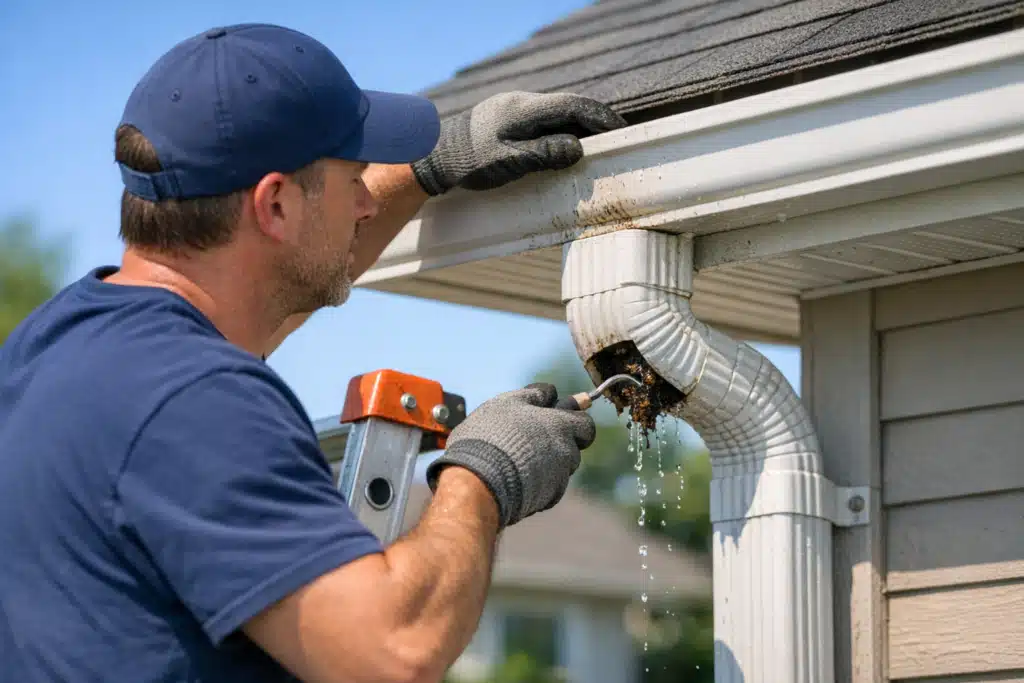
The gutter can look clean and still overflow. The blockage sits inside the downspout elbow, where debris wedges at the bend. Water rises in the gutter until it pours over the side.
How to Spot Gutter Overflow Before Water Damage Starts
Catch overflow early and you avoid the expensive fallout: rotted fascia, soaked foundations, and basement seepage. Watch for these signs during or right after a summer storm.
- Sheeting water pouring off the gutter edge instead of exiting the downspout
- Streaks or stains on the fascia board behind the gutter
- Paint peeling on the siding directly below a gutter run
- Pooling water against the foundation after rain stops
- Mud splash marks on lower siding from water hitting bare ground
- Sagging gutter sections pulling away from the fascia under water weight
A gutter full of water hours after a storm points to a downspout blockage. That is your cue to act before the next front rolls in.
Managing Gutter Overflows: A Step-by-Step Summer Plan
Stopping overflow during a high-rainfall summer takes timing, not just effort. Clear the system before storm season peaks, then check it between big fronts.
- Clear cottonwood and seed debris in early June. Do this after the fluff stops falling but before the first heavy July storm.
- Flush every downspout with a hose. Run water from the top. If it backs up, the elbow is clogged.
- Check the pitch. Water should run toward the downspout, not pool in the middle. A quarter-inch drop per ten feet moves water well.
- Inspect for gaps and sagging. Reseal loose seams and re-secure any bracket pulling away from the fascia.
- Verify water exits away from the foundation. Extensions should carry water at least four feet from the house.
- Re-check after each major storm. A single July hailstorm can drop enough grit and leaf litter to reclog a fresh gutter.
This mid-season recheck matters most in high-rainfall summers. One cleaning in spring will not hold if storms keep loading the gutter with debris.
Gutter Guards: Help or Hindrance in Heavy Rain?
Gutter guards reduce debris entry but change how water flows during intense rain. The results vary by guard type.
Mesh and Micro-Mesh Guards
Fine mesh blocks cottonwood fluff and seed pods well. In a hard downpour, though, the mesh can shed water over the front edge if the surface tension breaks. Grit buildup on top makes this worse over a summer.
Reverse-Curve Guards
These direct water around a lip while debris falls off the edge. In moderate rain they work. During a cloudburst, fast-moving water can overshoot the curve entirely and skip the gutter.
Foam and Brush Inserts
Foam fills the gutter channel and lets water pass over. In high rainfall, it clogs with fine sediment and holds moisture, feeding algae. It also shrinks how much water the gutter can carry.
The takeaway: Guards cut cleaning frequency but never eliminate it. In a high-rainfall summer, a guarded gutter still needs a mid-season inspection.

 Posted on Google
When Gutter Overflow Signals a Bigger Problem
Repeated overflow after a clean gutter usually means the system cannot handle your roof’s runoff volume. This is a sizing issue, not a debris issue.
Homes with large or steep roof planes may need upgrades to move summer storm water:
- 6-inch gutters instead of 5-inch, moving roughly 40 percent more water
- Larger 3×4-inch downspouts in place of standard 2×3-inch outlets
- Additional downspouts to split long gutter runs and cut travel distance
- Oversized outlets at the gutter-to-downspout connection to reduce choke points
If your gutters overflow every summer despite cleaning, the channel is undersized for your rainfall. A window and exterior cleaning visit can confirm where the water is escaping.
How Overflow Damages Your Windows and Siding
Gutter overflow does more than wet the ground. Water cascading past a window leaves mineral streaks, spots, and grime on the glass. Over a summer of storms, that residue etches into the surface.
Runoff also splashes dirt onto lower window frames and sills. Standing moisture near wood frames invites rot and paint failure. Clean gutters protect the glass and frames you paid to keep clear.
This is where gutter care and window care overlap. Handling both in one visit keeps your home’s exterior water-tight before peak storm season.
Conclusion
Gutter overflows during high-rainfall summers come down to debris, pitch, and drainage capacity. Clear your gutters in early June, flush the downspouts, and recheck after every major storm to keep water moving. If overflow keeps happening on a clean system, your gutters may be undersized for your roof.
Ease Your Panes handles gutter clearing and exterior window cleaning so summer storm water flows away from your home, not down your glass. Call or text (720)-477-3273, email info@easeyourpanes.com, or visit https://www.easeyourpanes.com to book before storm season peaks.




